From African fields to world markets.
Djalumo Agro industrialises African agriculture with data. It plans every season from any budget, starting at 100 USD, and connects the harvest to the markets that pay for it: in Cameroon, across Central Africa and, through the ports of Douala and Kribi, to the world.
From 100 USD, in any currency. The plan opens below.
Cameroon · field to port
One production zone, three horizons
Foumbot, in the West region of Cameroon, is one of the market garden basins that feed Douala and Yaoundé. From there, produce already moves by road to the neighbouring countries. Through the ports of Douala and Kribi, the same harvests can reach every major market. Djalumo Agro plans the season with the destination in mind.
Drag to pan, use the buttons to zoom, select a corridor or a market.
Today the pilot sells in Cameroon. Regional flows are documented market flows; export corridors are Djalumo Agro’s target, not current sales.
of bananas exported in 2024, mainly to the European Union
Assobacam via Business in Cameroon ↗Proof from the field, not from a slide.
Before the first line of code, a real farm: two sites in Foumbot, four production phases, every cost recorded and seventy-three photographs. These plates are the founding dataset of Djalumo Agro.
The father’s plantation
Where the craft and the seed come from
Launch on 1 ha
Main site
Secondary marshy site
0.25 ha
Staked tomato
Secondary site
Relaunch of the main site
1 ha

The father’s plantation
Tomato field at production stage, staked with bamboo.
September 2021 · Father’s plantation, Foumbot area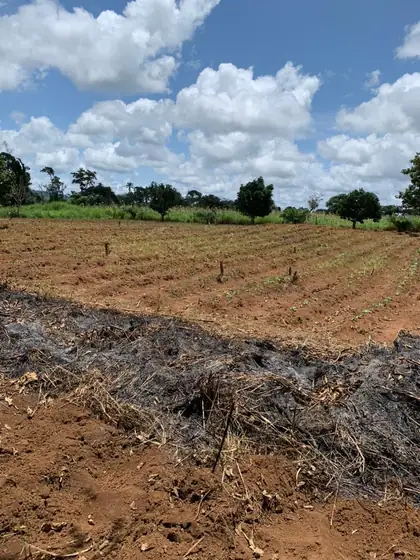
Land preparation and establishment
Burnt crop residues beside freshly planted rows.
Sept to Oct 2024 · Main site, 1 ha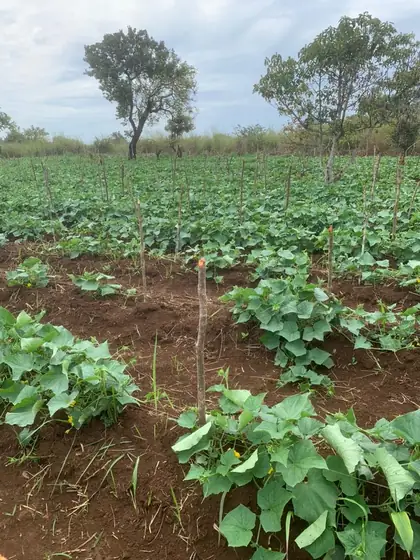
Crop development
Staked cucumber field in flower.
October 2024 · Main site, 1 ha
Water, the hidden cost
The founder starting the pump.
2024 to 2025 · Main site and secondary marshy site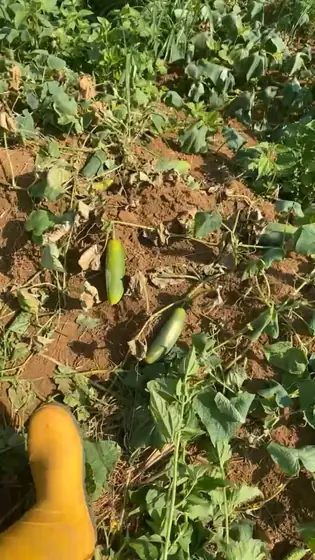
Climate and establishment stress
Cucumbers yellowed by heat and left unmarketable.
Oct 2024 to Feb 2025 · Both sites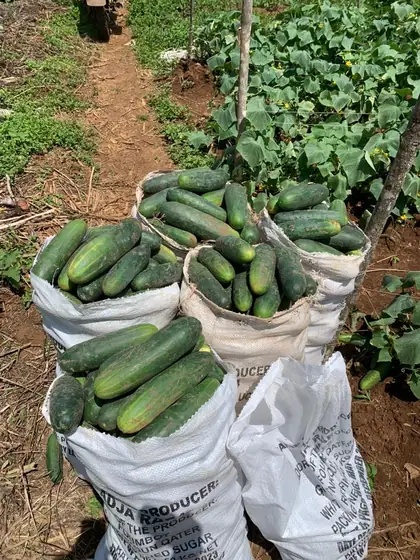
Harvest and sale without packaging
Cucumbers packed in a reused 50 kg sugar sack.
2024 to 2025 · Both sites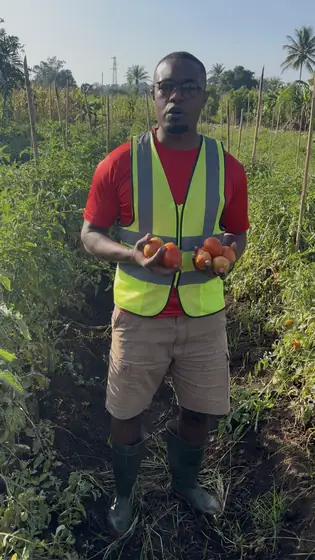
Production on the secondary site
The founder at tomato harvest.
Nov 2024 to Jul 2025 · Secondary marshy site, 0.25 ha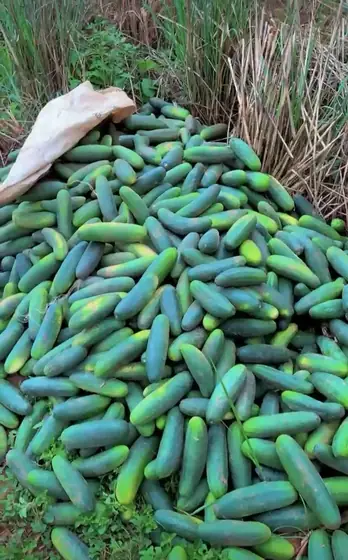
Relaunch of the main site
The first harvest, in the middle of October 2025.
Aug to Oct 2025 · Main site, 1 haAll photographs were taken by the founder and his team in the Foumbot area and are used with his permission.
Open the full field recordCapital is committed before the decisive facts are known.
A farmer spends most of a season’s capital in its first weeks, on land, seed, fertilizer and labour. Five factors then decide the outcome, and none of them is known with confidence at the moment of planting.
Missing: the local rainfall and temperature outlook for the weeks of flowering and harvest.
Missing: affordable soil information and an objective view of water, roads and wildlife.
Missing: price trends by market and by week, and visibility on competing supply.
Missing: a costed plan matching area, inputs and reserve to the money available.
Missing: a calendar of elections, holidays, road and security conditions.
Sources: Ministry of Agriculture and Rural Development figures reported by Business in Cameroon; World Bank, Cameroon overview.
The constraint is not land or labour. It is the quality of the decisions made before planting.
Raw data in. A decision out.
Public archives and field records are scattered, technical and rarely available in French. Djalumo Agro translates them into one decision for a specific plot, crop, date and budget.
Data
Climate, soil, crop, market and context, from public archives and field records.
Intelligence
An agronomic reference base structures the data by crop, stage and zone.
Prediction
Documented agronomic rules today, and models trained on field data from 2027, estimate climate risk, disease pressure, yield and price as ranges.
Decision
The Season Plan sizes the area to the capital and ranks the planting windows.
Action
The Season Plan guides the work; from the 2027 pilot, the season log compares plan and reality to sharpen the next plan.
Your capital, one costed season.
Capital, crop, water and start date: the planner sizes the plot, splits the budget along the standard itinerary and estimates the return from a good harvest to a failure.
At $0.43 per kg, the average margin is $3,911 over the season, +105% on the costs.
- With $5,000, the plan covers 0.51 ha.
- Harvest from Mar 11, 2027 to May 10, 2027.
No sourced price was found for this line: Stakes (bamboo or wood). It keeps its quantity but counts as zero in the budget: get a local quote before committing.
Only the average outcome is shown here. The full plan details the budget line by line, the technical itinerary, the shopping list, the water balance and the risks.
From 100 USD to more than 1 million. One engine.
The tiers describe the depth of the plan, not separate products. A farmer who starts at 500 USD keeps the same account, history and data when the farm grows to 50,000 USD.
Starter
The crop and plot size the budget can carry, an affordable input list, a nursery and planting calendar, and a clear warning when the budget is too small.
Smallholder
A full Season Plan for one to a few hectares: water plan, pest calendar, sales plan, margin in four outcomes.
Commercial
Several crops and staggered plantings, irrigation and equipment sizing, packaging and logistics options, labour plan.
Industrial
A portfolio of sites and crops, supply forecasts for buyers and processors, risk reports for lenders and insurers, API access.
Stay ahead of agricultural intelligence.
Field notes from Foumbot, model progress, data sources and release news. Sent occasionally, in English or French. Unsubscribe at any time.
Bring Djalumo Agro to your farms, portfolio or programme.
Pilot participation in Foumbot from March 2027, data partnerships, investment and institutional collaboration.